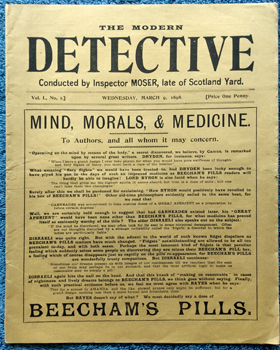
MOSER, Inspector Maurice ... late of Scotland Yard. The Modern Detective; or Shadows & Shadowland & the Crime Investigator. Vol. 1.: No. 1. [all published?]. London, 1898, March 9. 31x25cm publisher's printed wrapper; 20pp; illustrations in half-tone and line. Minor signs of use; rather good. Au$300
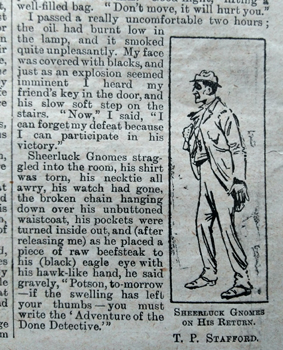
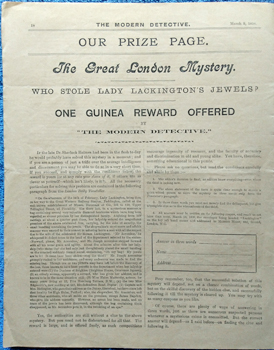
All published it seems and rare.Worldcat finds one entry for this one issue and I can't add to that. I would have thought the 1890s was a fine time to start a detective magazine but I suspect a deeper purse than The Modern Detective displays was necessary. Even prizes for a new design of handcuffs and for the solution to the theft of Lady Lackington's jewels could not spur sales enough to justify a second number. Not even the appearance of The Misadventures of Sheerluck Gnomes by a T.P. Stafford.
Inspector Moser (late of Scotland Yard) published a book or two of ostensible real life stories from his time at the yard a few years earlier and an article on handcuffs in the Strand in 1894 but vanishes into the shadowland of literary hacks after this. He seems destined to be remembered as the unpleasant private detective who unwillingly gave his name to woman detective Antonia Moser after their rupture.
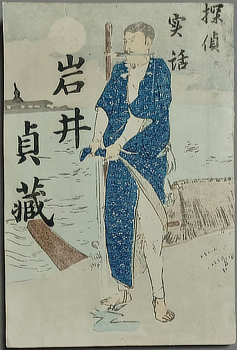
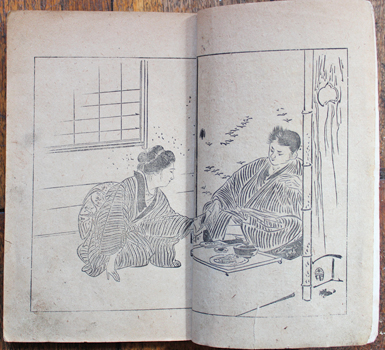
Amano Kaoru (preface). 探偵実話 : 岩井貞藏 [Tanteijitsuwa : Iwai Teizo]. Tokyo? Nakamura Sojiro 1898 (Meiji 31). 21x14 publisher's colour illustrated wrapper; three double page illustrations. With expert repairs to the spine and a new back wrapper. An excellent, fresh copy in a case by binder, writer and fastidious collector Ikuta Atsuo. Au$200
First edition. I bought this under the heading of, (roughly translated) Real life heinous murderer. We can discard the real life immediately. The preface is by Amano Kaoru, almost as obscure as anonymous, the author. I can't find a record of this anywhere but a publisher's advertisement in another book.
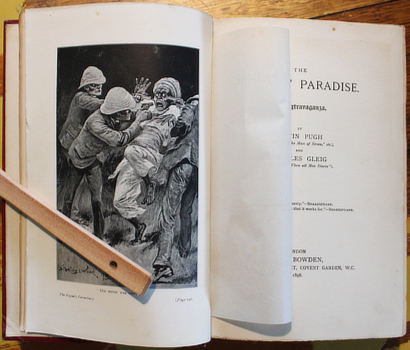
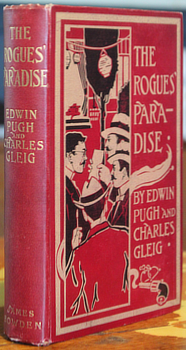
PUGH, Edwin & Charles Gleig. The Rogues' Paradise. An extravaganza. London, Bowden 1898. Octavo publisher's illustrated dark red cloth blocked in black and white; frontispiece by Stanley L. Wood. A pleasing copy. Au$225
First edition of this criminal romp set in the vaguely situated tropical country of Berona, a haven for Britons fleeing society or the police. This reads like it aimed to be a play or was worked from one, with a hefty dose of Oscar Wilde banter early on and finishes as farce with lightning fast entrances and exits, misdirection and sotto voce asides all over the place.
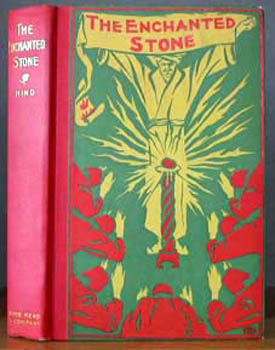
HIND, Lewis. The Enchanted Stone. NY, Dodd Mead 1899. Octavo publisher's cloth & colour illustrated boards. Outstanding in probably the original tissue wrapper. Au$200
First American edition, which apparently differs from the English edition. I haven't found out what those differences are, I suspect few people have read both. A fantasy involving magic, mysterious orientals and suchlike. I think this is Hind's first book.
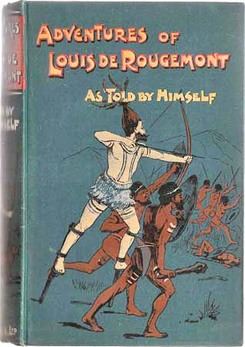
de Rougemont, Louis. [Henri Grien]. The Adventures of Louis de Rougemont as told by himself. London, Newnes 1899. Octavo publisher's illustrated cloth; 46 illustrations, some full page. A bit of a lean but an excellent bright copy. Au$200
First edition, with the preface by the editor of World Wide, Fitzgerald. I have seen copies with this removed - embarrassment after de Rougemont was definitively proved a liar? Grien did make living as 'The Greatest Liar on Earth' for a while, and likely a better living than his apparently sad true life in Australia. Once a common book but getting hard to find in decent condition.
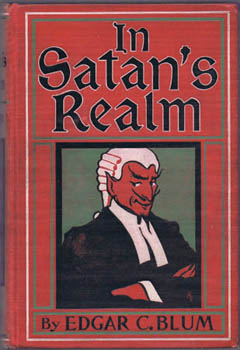
BLUM, Edgar C. In Satan's Realm. Chicago, Rand McNally 1899. Octavo publisher's illustrated red cloth blocked in green, black and white. A read copy but still quite a good copy. Inscribed by the author to a friend. Au$185
First edition. The story of a too successful journalist who begins rather than ends his greatest adventure by being eaten by a cannibal. He goes first to heaven but his 'reportorial instincts' had him quickly banished to hell.
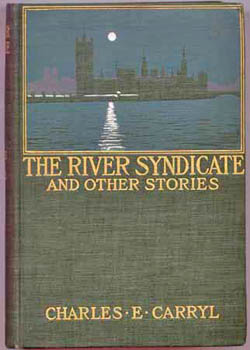
CARRYL, Charles E. The River Syndicate and Other Stories. New York, Harper 1899. Octavo, very good in publisher's green illustrated cloth blocked in gilt and colours; four plates. Au$125
First edition; detective fiction and lesser thrillers. Known for his childrens' books and poetry this is apparently Carryl's only entry into the genre.
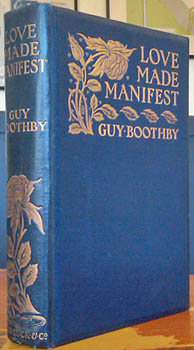
BOOTHBY, Guy. Love Made Manifest. London, Ward Lock [1899]. Octavo publisher's decorated blue cloth blocked in gilt. Endpapers a bit browned as usual, a pleasing bright copy. Au$125
First edition. From Apia to Sydney to Belgrave Square our hero wins his way to fame and fortune only to find a peril worse than any of Boothby's opium addled Asiatic fiends lying in wait for him.
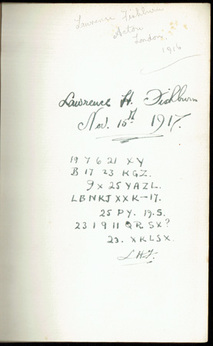
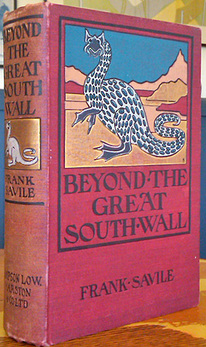
SAVILE, Frank. Beyond the Great South Wall - being some surprising details of the voyage of the S.Y. Racoon. London, Sampson Low &c 1899. Octavo publisher's illustrated red cloth blocked in black, white, gilt and blue (spine a bit faded and rubbed); [6],302pp and 10pp publisher's list included in the last gathering. A bit used, browning of the endpapers and round the edges. Inscription of a Lawrence Fishburn dated 1916 and 1917 on the front endpaper with a short message written in some secret code. Pretty good; as this is the only copy I've found after some years of looking I can't compare it to others. Au$1500
First edition and close enough to rare. George Locke noted in the first volume of his Spectrum of Fantasy (1980) that he'd traded his way up to a good first American edition but not yet seen this. At the end of volume two he announced that, in 1993, he'd seen and finally got one. These original sheets were re-issued as an undated 'cheap edition' with a cancel title page and, I suspect, sat in the warehouse for decades - the only copy of that I've seen was apparently bought new and given as a prize in 1927. In other words it was a forgotten dud. How? with that cover? who could resist it? It seems to have been better received in America where it had two editions in 1901 and received a friendly notice in the NY Times.
This is an Antarctic adventure discovering a now extinct Mayan civilization and a not extinct prehistoric monster. By no means the worst lost race novel ever written; indeed it stands proud of most Antarctic novels in being brisk, breezy and easy going.
GRIFFITH, George. Gambles With Destiny. London, F.V. White 1899. Octavo publisher's cloth (tips a little worn). Endpapers spotted, a pretty good copy with Ronald E. Graham's Virgil Finlay bookplate. Au$185
First edition of this collection of shorter things, mostly sci-fi or fantasy - one of which introduces the countdown: 10, 9, 8 ...; another involves a Faustian bargain made with haschisch.
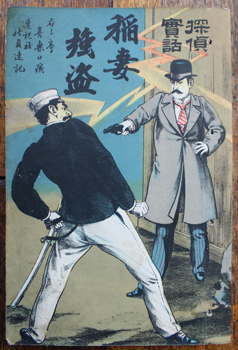
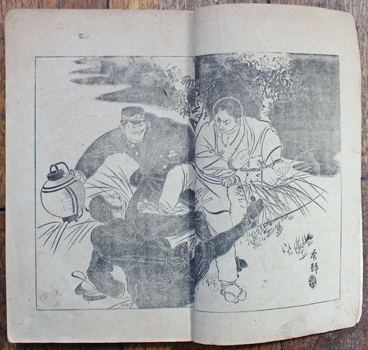
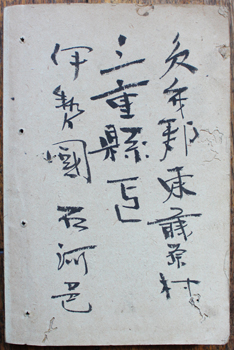
Dondontei Kiraku. 探偵実譚 : 稲妻強盗 [Tantei Jittan : Inazuma Goto]. Tokyo, Seiyodo 1899 (Meiji 32). 22x14cm publisher's colour illustrated wrapper; two double page frontispieces. Inked inscription on the back blank and last leaf of text; expected browning of the paper, some smudges and small flaws, rather good. Stab holes indicate this was once bound with something else. Without a back wrapper as issued, the colophon leaf is mounted over the neat stub of the front cover and spine. The NDL digital copy has advertising on the back of the colophon leaf - this one is blank - and at first glance has what appears to be a back wrapper but is a dark photocopy (probably) of the front wrapper mounted inside the back cover. Au$250
Japan's first pistol packing robber was Shimizu Sadakichi, arrested in 1887 after a five year rampage and five murders. Shimizu was called the pistol robber. He was finally captured by policeman Ogawa Yoshiro who died the next year from his wounds. A bridge was named in his honour but the river was filled in and the bridge removed. He since got a plaque.
But 1899's Lightning Robber - Inazuma Goto, the title of this book - was Sakamoto Keijiro, arrested in February1899 after escaping jail in 1895, a lot of robberies and three murders. Nothing about him using a gun, though. Nor do I believe he did a lot of thieving in bowler and overcoat.
This was the stuff of sensation mongering of course, plays were performed in 1897 and 1899 and at least one other book appeared, in 1893. In 1899 four or more books called Lightning Robber appeared; that is, I found four titles but I don't know how many of them are different books. Japan's first feature film, 'Pisutoru Goto Shimizu Sadakichi' (pistol robber Shimizu Sadakichi) but also called 'Inazuma Goto', appeared the same year. Clearly Sakamoto's arrest sparked a frenzy of cash-ins, Shimizu was instantly resurrected and the pair conflated into the formidable desperado we see on this cover.
Remember, though, that this is a "true detective story" so I'm sure it's not as confusing as this description.Worldcat finds no copies outside Japan.
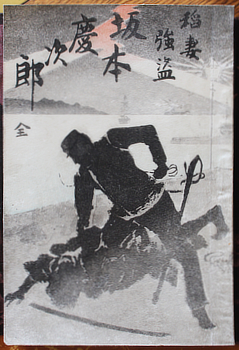
Lightning Robber. 稲妻強盗 : 坂本慶次郎 [Inazuma Goto : Sakamoto Keijiro]. Tokyo, Sanshindo 1899 (Meiji 32*). 21x14cm, publisher's colour illustrated wrapper; three double page illustrations. The wrapper and last leaf (this was not issued with a back wrapper, an advertisement leaf was joined to a stub of the cover and spine) have been repaired but I'm not sure how much. It is so near invisible. An excellent, fresh copy in a chic case by binder, writer and fastidious collector Ikuta Atsuo. Au$250
Third edition, three months after the first. The Lightning Robber - Inazuma Goto, the title of this book - was Sakamoto Keijiro, arrested in February1899 after escaping jail in 1895, a lot of robberies and three murders. This was the stuff of sensation mongering of course, plays were performed in 1897 and 1899. In 1899 four or more books called Lightning Robber appeared; that is, I found four titles but I don't know how many of them are different books.
This seems to have 24 more pages than what is likely the first edition, published by Kinshindo, and either uses the same sheets or was printed from the same plates.
*But. Those extra pages finish with his death in February 1900, months after the date on the colophon printed on the other side of the same page. Can publishers ever be trusted?
The Lightning Robber was conflated with the previous decade's Pistol Robber and one of our four or so books shows him in bowler and overcoat firing at a policeman. Japan's first feature film, 'Pisutoru Goto Shimizu Sadakichi' (pistol robber Shimizu Sadakichi) but also called 'Inazuma Goto', appeared the same year.
Worldcat does not find this version and none of their four titles are found outside Japan.
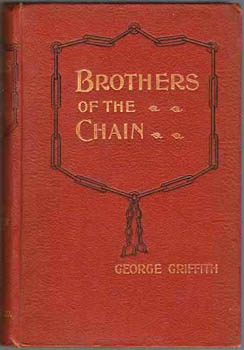
GRIFFITH, George. Brothers of the Chain. London, White 1900. Octavo publisher's grained cloth blocked in gilt and black. A rather good, bright copy of a book that usually hasn't aged gracefully. Au$325
First edition, second issue with a cancel title; copies are known to exist with the title dated 1899, but not many. The colonial edition though is dated 1899. One of Griffith's baroque thrillers of particular interest to us in the Pacific. "In the triple-walled fastness of the Central Prison on Ile Nou, in New Caledonia there exists, so those who should know, say, the head centre of the most mysterious and the most terrible secret society in which men, or rather fiends in human form, ever bound themselves together." This is not from the novel but from Griffin's Pearson's Weekly article - Griffin building a buttress of supposed fact to support his fiction. The book itself leaps around the world, from Park Lane and Paris to the seas off north Australia and New Caledonia.
Trove finds only one copy, in the Ron Graham collection at Sydney University. The non-fiction follow-up on the convicts of New Caledonia, In an Unknown Prison Land (1901), is well represented.
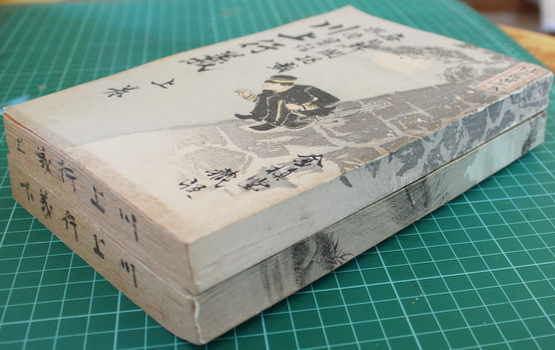
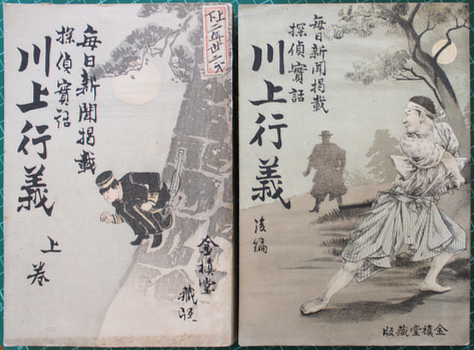
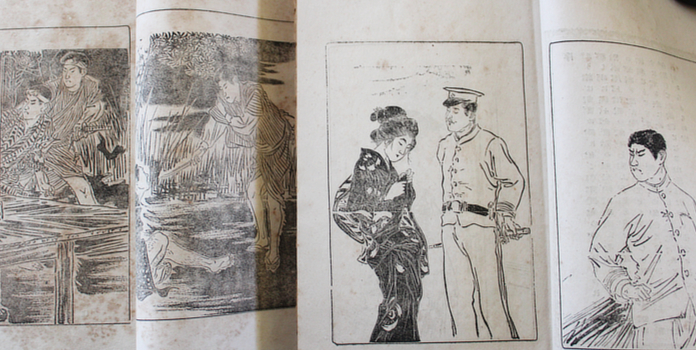
Aoba (ie Ihara Toshiro?). 川上行義 : 探偵実話 [Kawakami Yukiyoshi : Tantei Jitsuwa]. Tokyo, Kinshindo 1900 (Meiji 33). Two volumes 22x15cm publisher's colour woodcut wrappers; full page b/w illustrations in each volume, a couple double page. Browning of the cheap paper in the second volume, not so much in the first. A couple of owner's stamps; title written in ink on the bottom edges of each. Signs of use but pretty good. Au$250
First edition of this rare true detective story; that's what the subtitle says it is (true detective, not the rare bit). This is the story of Kawakami Yukiyoshi, an army sergeant who deserted in 1880 in order to avenge his father. He became a hero and a slight six part novel called (more lor less), A new Story : Kawakami Yukiyoshi's Revenge by Okamoto Kisen appeared in 1881. That looks like it came came directly from a kabuki production or would soon be one.
Ihara did a run of true detective novels early in his career before he became a distinguished theatre critic and playwright.
Worldcat finds only the NDL entry and Cinii finds only two locations in Japan.

WALSH, George E. The Mysterious Burglar. New York, Buckles 1901. Octavo, excellent in publisher's illustrated green cloth. Au$100
First edition. A working burglar falls in with a mysterious gentleman burglar and becomes determined to unravel his secret.
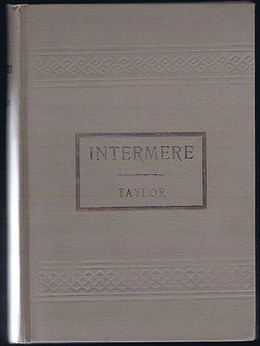
TAYLOR, William Alexander. Intermere. Columbus, XX. Century Pub. Co. 1901-1902. Octavo publisher's grey cloth; 148pp, frontispiece portrait. An inserted publisher's card advertising the book has made a faint brown patch on the title but this copy is pretty well as new. Au$250
First edition. An Antarctic lost race race utopian thriller. Again a ship, or in this case yacht, is enveloped in fog; comes a mighty storm and the narrator finds himself in an unknown land. Intermere is populated by a physically, mentally, scientifically and socially advanced race.
The book exists in a plethora of different coloured cloths but I don't know of any, and don't see any reason to look for, issue points.
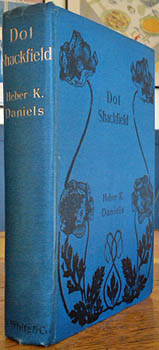
DANIELS, Heber K. (Farquhar Edward Palliser). Dol Shackfield: a novel. London, F.V. White 1901. Octavo publisher's decorated blue cloth blocked in black. Light signs of use, an attractive copy. Au$125
First edition of a melocomic crime thriller so far unknown to Hubin. The heroine could kindly be labelled irrepressible and so she is to the extent that you might wish her secret husband did succeed in murdering her.
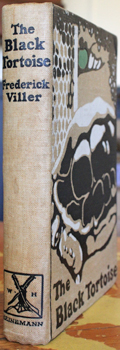
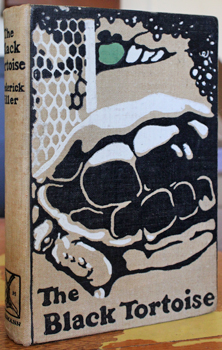
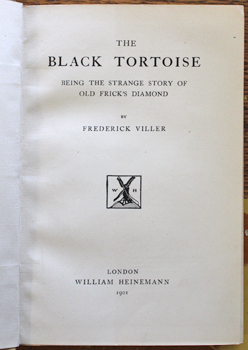
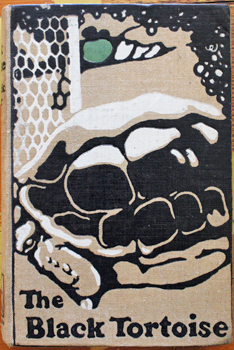
VILLER, Frederick. [Christian Sparre?]. The Black Tortoise : being the strange story of old Frick's Diamond. London, Heinemann 1901. Octavo publisher's illustrated tan cloth blocked in black, white and green. Rear endpaper removed but a nice fresh copy. Au$275
First English edition of an early piece of Nordic noir - only the rude would call it Norwegian wood. I think this is the second book of Inspector Monk, published in Norwegian in 1898, and the only one translated into English then and maybe still.
I was going to ask how it is that rich tiresome old farts like Frick always have a lovely daughter but I remember that I have a lovely daughter without being rich. Anyway, she's his niece. Still, it's a troublesome family for Monk to marry into. He's going to spend the rest of his life recovering that damn Black Tortoise. Only a few chapters in it's already been stolen three times.
Then there's the indefinably sinister young Australian: the son of Frick's old friend and rescuer from the Victorian gold fields. Frick's house is named Ballarat in honour of his halcyon days when he spent three years as "sherriff" of Ballarat and made the first part of his fortune. There's no murder but two suicides help balance the score.
The binding is so much like William Nicholson, who was published by Heinemann and designed Heinemann's logo, that I'm convinced.
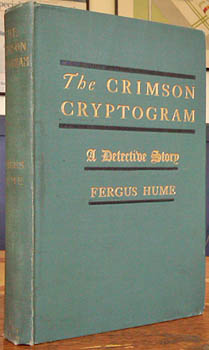
HUME, Fergus. The Crimson Cryptogram. A Detective Story. NY, New Amsterdam 1902. Octavo publisher's cloth (spine a bit rubbed). Quite a good copy. Au$90
First American edition, the London edition appeared in 1900. Is it an unlikely coincidence that young doctor Ellis happens to be discussing Moxton and his wife the moment his first ever patient rings the bell: Mrs Moxton to announce that her husband has been murdered? Coincidence schmoincidence, such things are beneath notice. Is it any more likely that characters in film and tv still - after years of mockery - always find a parking space right outside their destination?
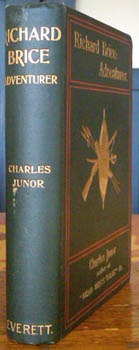
JUNOR, Charles. Richard Brice: Adventurer. London, Everett 1902. Octavo publisher's decorated cloth blocked in gilt and maroon. Small, very small, hole in the spine; a bit of foxing; quite good. Au$1450
First edition of Junor's other book and rare; missed by Miller and Macartney and by Loder. Not the first appearance, a version was serialised with the title 'A Ruby from the Sea' in The Murrurundi Times and Liverpool Plains Gazette from March to November 1901. Junor's first book was, of course, 'Dead Mens' Tales' of 1898 and as he fell off a Sydney ferry and drowned while this was in the press there were no more.
Junor has aimed at an international market while keeping one foot in the home camp. The hero and narrator is Australian born but brought up in Argentina. Finding himself on the run after a misjudged coup d'etat he decides to head for London and then on to Australia. Manila is as close as he gets and long before he gets that far he has been through a multitude of perilous scrapes, subterfuges and double crosses. There is a possibility that some autobiography went into this. Maybe not the bloodshed and Spanish American war in the Philippines but many of the locations, from Argentina onwards.
Information on Junor is scant, here's what I've gleaned. According to the inquest report Junor was a South American born 37 year old journalist of North Sydney, and married. His "young and pretty" widow Minnie remarried in 1904. When he came to Australia is still mirky but his name begins to appear in Melbourne newspapers around 1890. Two pamphlets published in London in 1885 by the freethinking, and sometimes blasphemous, Progressive Publishing Co were authored by a Charles Junor. He would have been very young then but it is possible that this is our Junor; particularly since both pamphlets are in the SLNSW while only one can be traced in OCLC or Copac.
Junor was a Melbourne scribbler for newspapers until the late 1890s when he migrated to Sydney. He had occasional 'Comments of a Melbournian' published in provincial Victorian papers and stories that went into his 'Dead Mens' Tales' appeared in papers scattered all over the place. His most successful writing, in terms of exposure, were two testimonials he wrote for Clements Tonic. He had two other jobs: assistant to a politician in Melbourne and assistant secretary to the AAAS at Sydney University.
I suspect that reports of the inquest into his death are purposely close mouthed and coded - maybe loyalty to a fellow journalist - but no mortal brain can ever comprehend why and what journalists choose to report or omit. Given he was on a late Saturday night ferry to Milsons Point, was woken on arrival by a friend, stepped over the ferry rail and went into the water I'd guess he was drunk. Or given that his employer testified he was noticeably absent minded perhaps we could say he was absent minded as a newt.
A search of all the likely catalogues finds copies in the four English deposit libraries, two in Australia and one belonging to the Mormons in Utah.
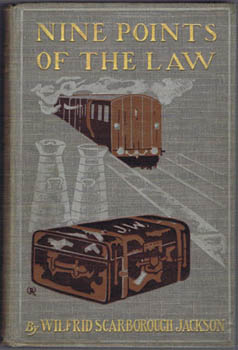
JACKSON, Wilfrid S. Nine Points of the Law. London, John Lane 1903. Octavo publisher's illustrated cloth blocked in git, white and brown. A few spots at the edges and ends, a rather good copy. Au$165
First edition. A goodhearted thriller with a Candide-like hero dragged into action and wrongfully suspected. This appears to be Jackson's first book and his only mystery. He published a couple more novels but none seem to have set the world on fire (though his next novel 'Helen of Troy, NY' got a good notice in the NY Times) and he settled into a steady career as a translator and general man-of-letters.
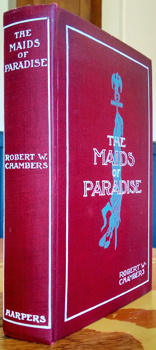
CHAMBERS, Robert W. The Maids of Paradise. A novel. NY, Harpers 1903. Octavo publisher's red cloth blocked in white and green; eight plates. A remarkably bright copy. Au$65
First edition. A spy thriller set during the Franco-Prussian war involving socialists and German spies. There is also a circus thrown in with a bit of lion taming gone wrong.

PEMBERTON, Max. Doctor Xavier. NY, Appleton 1903. Octavo publisher's illustrated cloth blocked in gilt, red and white; eight plates by Greiffenhagen. Minor signs of use. Au$50
First American edition; the London edition also appeared in 1903. A Spanish Ruritanian romance, if that makes sense. The small kingdom of Cadi, its handsome prince, the innocent young English beauty, and the nefarious Doctor Xavier are at its centre.
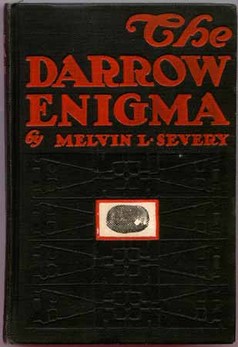
SEVERY, Melvin L. The Darrow Enigma. New York, Dodd Mead 1904. Octavo, very good in publisher's black cloth blocked in blind and red with a small onlay (a touch rubbed); illustrations by C.D. Williams. Au$100
First edition; a laboured locked room mystery. I came across a relatively recent defence mounted by Severy's great grand-daughter against ridicule of Severy's science and his unlikely invention of a lawyer-chemist hero. First she pointed out that Severy was a successful inventor whose science was sound; then that she was herself a lawyer-chemist.
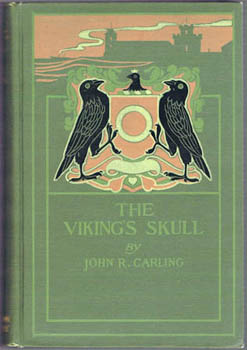
CARLING, John R. The Viking's Skull. Boston, Little Brown 1904. Octavo publisher's illustrated green cloth printed in colours; four plates. An excellent, bright copy. Au$100
First edition of this convoluted, unfair, mildly occult thriller. "An ingeniously constructed plot, which tells how Idris Marville, true Earl of Ormsby recovered a treasure hidden by one of his progenitors - a Viking of the Ninth Century - and how he cleared the memory of his father, who had been wrongfully convicted of murder" - publisher's advertisement - which is both a spoiler and mostly untrue. All the detective work was done by the two beautiful women who love him. And since the spoiler is already in I can tell you that of course it's not a viking's skull. To this we add, "Yet even amidst her fear it did not escape her notice that the hand which held the weapon was small, white, and decorated with a diamond ring" (p33). Sometimes a black silk vizard is just not disguise enough. But is it a useful clue? No.
  2 3 4 [5] 6 7 8   |