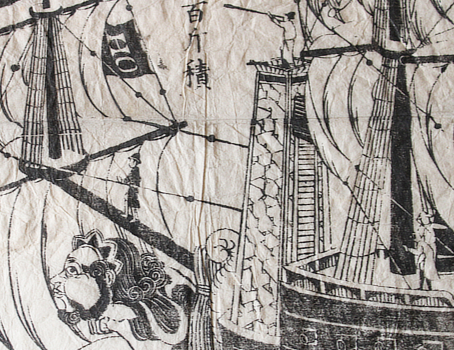
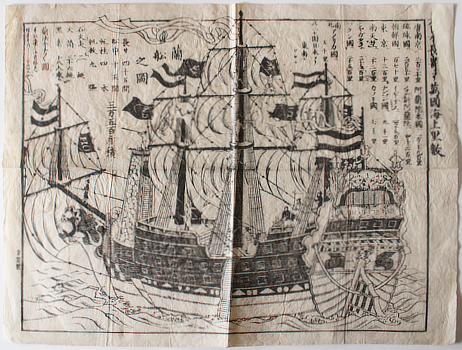
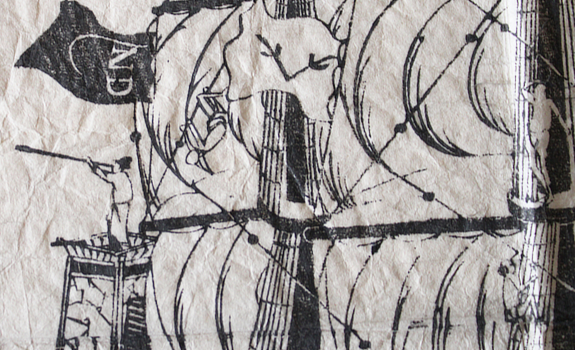
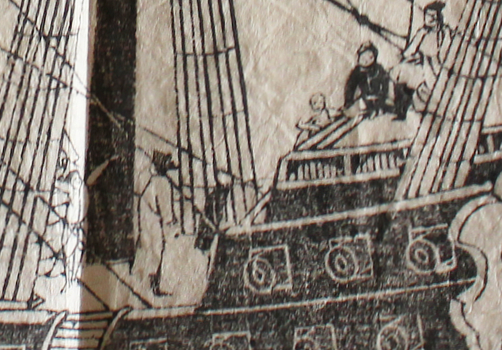
Kawaraban. 大日本長崎ヨリ萬國海上里數 [Dai Nihon Nagasaki Yori Yorozu Kuni Kaijo Risu?]. n.p. earlyish to mid 19th century. Woodcut 32x41cm. Piece torn from the right edge affecting a few characters repaired. Still, a good copy. Au$500

The classic Dutch ship was a required souvenir for every Japanese tourist in Nagasaki and, in various forms and fancies, was dusted off and reworked all over Japan every time a stranger appeared around Japan. This may have been occasioned by news of a Russian ship, American, British, or to fill in a dull patch in the foreign barbarian trade.
Maybe hard to see in my shaky pictures but this is one cheery bunch of sailors. They look more like they are having fun than working.
Kawarabans were illicit news sheets for the streets and produced by the million for a couple of hundred years so of course few survive. They were produced for anything more interesting than the drop of a hat. Foreign visitors were exciting news, much less common, than flood, fire, quake, and famine.


You can email an inquiry or order securely through antiqbook

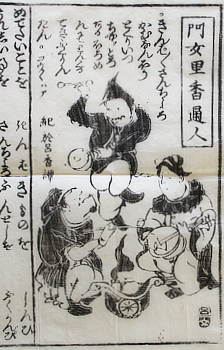
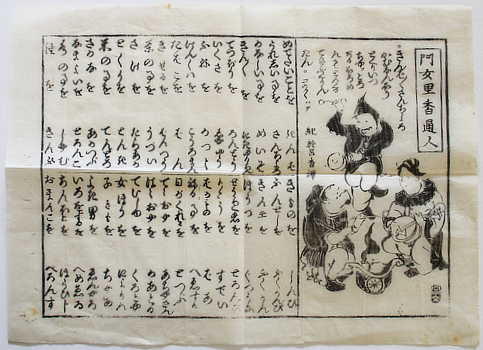
Kawaraban. Perry and the black ships. 阿女里香通人 [Amerikatsujin]. n.p. [1854] 23x31cm woodcut. Folded; rather good. Au$300

This lesson in the American language might be useless but when has that been an impediment to success? Those three figures are Americans having fun and that's a list of Japanese words or phrases and phonetic transcriptions from American. One ('child') is not too far off. Since the translator signs himself as 'foolish' was it ever meant to be taken seriously? I'm sure the artist's seal, something rarely, perhaps never, seen on a kawaraban is also a joke but it's too subtle for me.
In one piece I found on this print the writer found it necessary to blur the last two words but the less prudish Tokyo Museum, thank goodness, transcribed them all. So you get a good idea of what the children and vulgar of Edo were chanting or shouting at each other. No American would have understood what they were saying but they knew what they meant.


You can email an inquiry or order securely through antiqbook

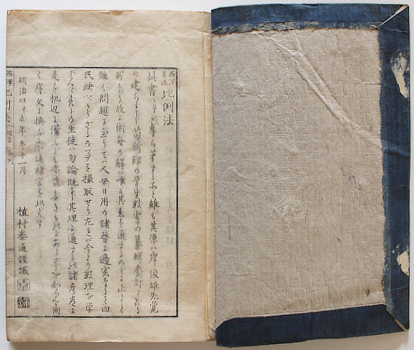
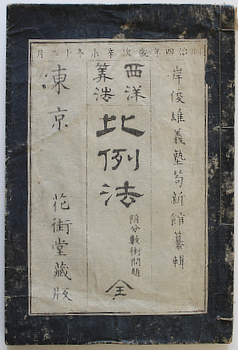
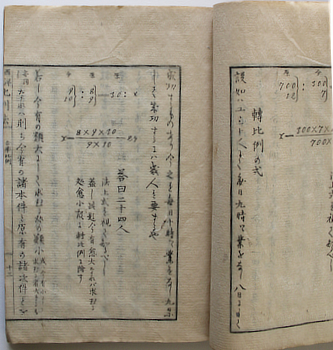
Kishi Toshio. 西洋算法 : 比例法 附分数術問題 [Seiyo Sanpo : Hireiho Bunjutsu Mondai]. Tokyo, Kagaido 1871 (Meiji 4). 23x15cm publisher's? wrapper with mounted title. Signs of use but pretty good for an old maths book. That's the title page mounted on the front cover, likely removed before binding. Au$135

Japanese students are introduced to simple western algebra and proportional ratios. Until the 1860s and the establishment of modern schools - for officers at first - western mathematics, like all things western, was the domain of a few curious scholars. Mathemeticians gave credit to the west in astronomy but judged western theory decidely inferior. Such disdain was of no use to a government determined to know everything. Mathematics came after languages, history, geography ... but not by much.


You can email an inquiry or order securely through antiqbook

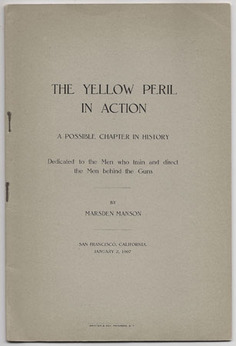
MANSON, Marsden. The Yellow Peril in Action. A possible chapter in history. Privately published, San Francisco, January 1907. Octavo publisher's printed wrapper; 32pp (including two blank leaves at the end), folding map. Au$125

A salutary piece of yellow peril literature, this is the history of the war between the USA and China - with help from Japan - in 1910. I can tell you now it didn't end well for America. Manson was the San Francisco City Engineer during the immediate post earthquake years and some of his predilection for technical detail has crept in here. This understandable desire to reinforce polemic with fact is the mark of the amateur and usually the reason why such tales are forgotten but Manson hasn't tried to disguise his aim with fiction; a fair bit is straightforward xenophobic agitprop.
I wonder how much the cataclysm of the San Francisco earthquake and fire had to do with this but I find no direct mention. Is it odd that it went to press so soon after the quake - Manson's preface is dated December 1906 - without a word? Did Manson think the shock of the quake was a good prompt for a battered public to take notice of an even greater threat? Certainly there was a movement to push the Chinese out of central San Francisco as rebuilding began. Was this a misguided bit of timing that guaranteed his pamphlet would be ignored?


You can email an inquiry or order securely through antiqbook

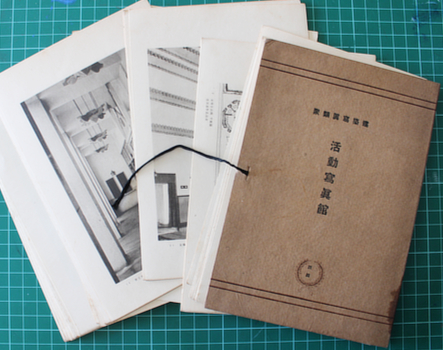
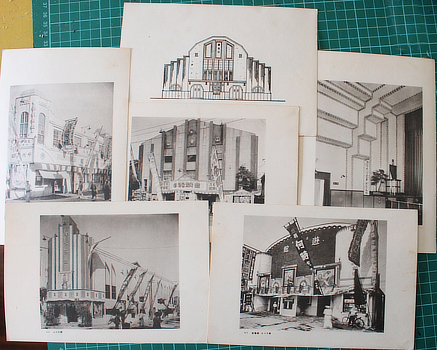
Cinema architecture. 活動写真館 [Katsudo Shashinkan]. Tokyo, Koyosha 1924 (Taisho 13). 19x13cm loose as issued in publisher's printed boards (spine with a stain); title and 50 leaves of photo illustrations, plans and elevations. Two plates have pin holes in the corners and one of those has marks of some sort of mistreatment (not fatal). Au$300

Tokyo cinemas, which by definition have to be recent; doubly so since these have been built since the earthquake. Which explains why many look like they've been dropped into a bit of wasteland, these have been built since September of the previous year. The editor tells us he's had to leave out several still in construction while Yokohama cinemas were left out because there weren't any good ones. In May 1924 (when this was issued) a lot of Tokyo life was still happening in shacks, sheds and barracks.
One of the apparently endless series of small architecture monographs, Kenchiku Shashin Riuju. I wonder if anyone knows how many there were. Some are intriguing and some are pretty drab. Many require a dogged love of gateways and tea rooms. This one is up top.


You can email an inquiry or order securely through antiqbook

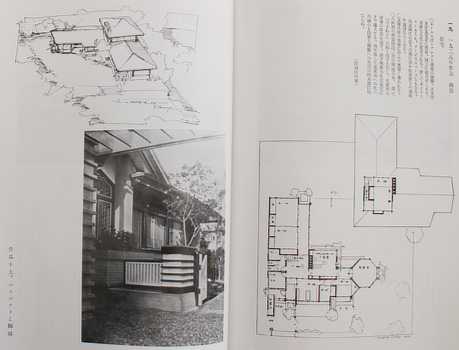
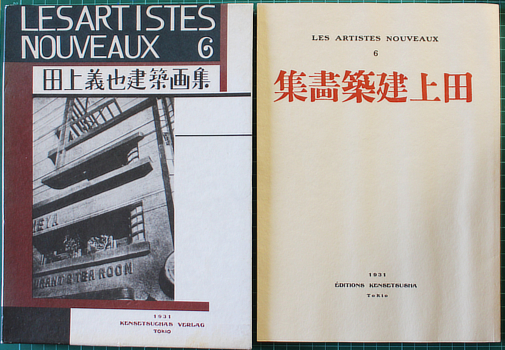
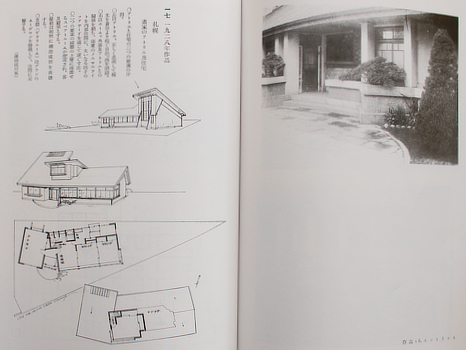
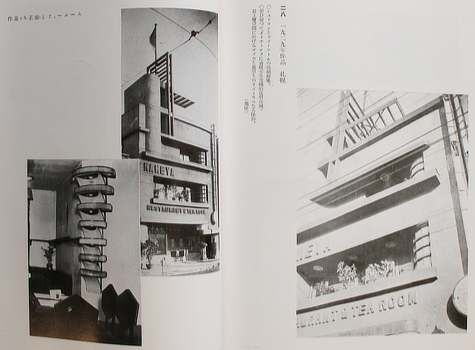
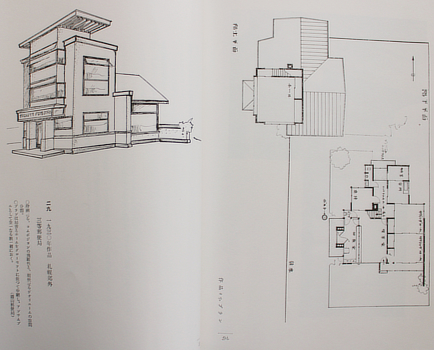
Tanoe [or Tanoue or Tanouye] Yoshiya. 田上義也建築画集  [Tanoe Yoshiya Kenchiku Gashu]. Tokyo, Kensetsusha 1931 (but Raifushuppansha 1987). 27x19cm publisher's printed wrapper, illustrated card slipcase; 110pp, photo illustrations, renderings and plans. At cost price. Au$250

Not the great bargain I hoped for. This is not the first edition, it's a facsimile I didn't know existed until I unwrapped this. It's a good facsimile, very good, and it's more obscure than the original. It's a local production by a Hokkaido publisher - not to be confused with current Tokyo 'Life Publishing' which deals in puerile self help stuff.
Tanoe began his career working for Wright on the Imperial Hotel - from 1919 to 1923. He then headed off to Hokkaido and is now an architectural hero of the island. The prairie style is evident in some of these early houses but no more than Japan is evident in the prairie style. I read somewhere that for one of the buildings in this book he kept his original plan rather than the compacted plan that was actually built. This was so that his sense of space was preserved.
I think the rest of this Artistes Nouveaux series - maybe seven titles in all - are all painters including three Europeans: Matisse, Vlaminck and Chagall. The others weren't reprinted of course.
Worldcat finds no copies outside Japan and it's not common in Japan, neither the original nor this reprint. At cost price.


You can email an inquiry or order securely through antiqbook

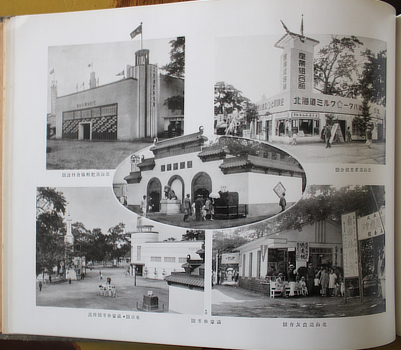
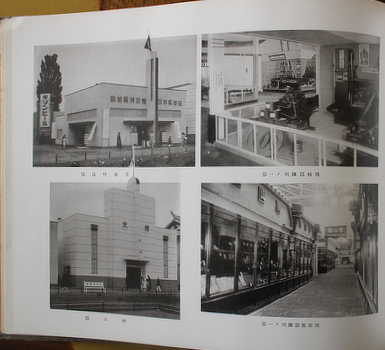
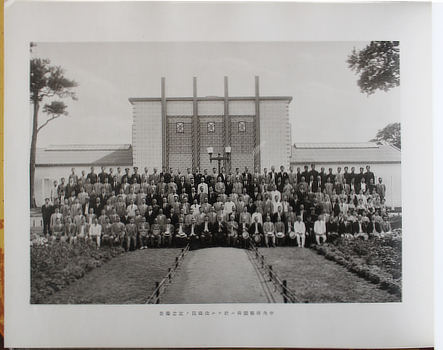
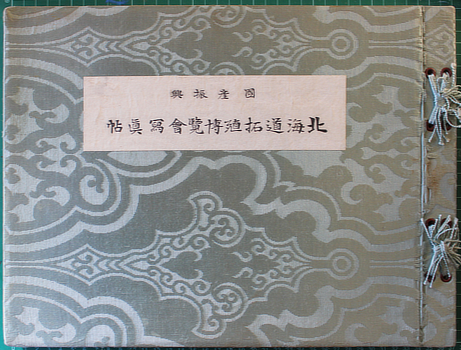
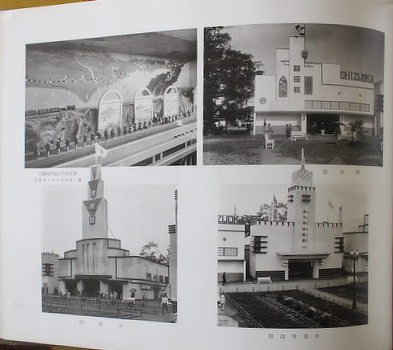
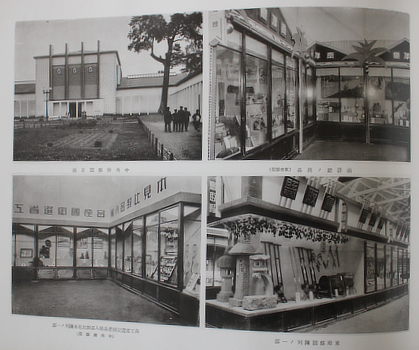
Exposition - Hokkaido 1931. 国産振興北海道拓殖博覧会記念写真帖 [Kokusan Shinko Hokkaido Takushoku Hakurankai Kinen Shashin Jo]. Hokkaido Takushoku Hakurankai, 1931 (Showa 6). 27x37cm publisher's patterned silk, cord ties; title page, photo illustrations on 35 leaves of heavy gloss paper, 12 pages of text and a plan. A nice copy. Au$600

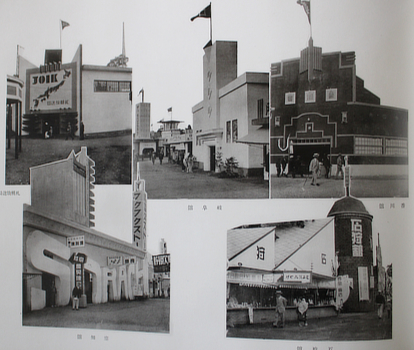
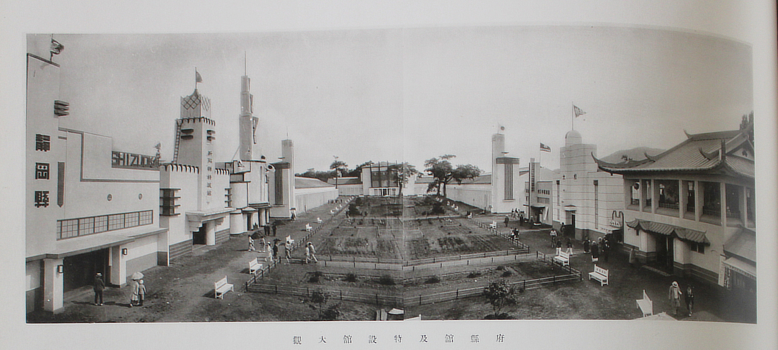
A luxurous celebration, with exemplary printing, of the 1931 Hokkaido Colonization Exposition. Had you heard of it? Me neither. Thankfully the important old men who always head such books don't take up too much space and it gets more interesting the further we go in. What's wonderful is the number of pavilions that might have come straight out of the pages of the exposition volume of the Gendai Shogyo Bijutsu Zenshu - the Complete Commercial Artist - of 1928-30. Either the same designers were at work or the organisers handed out copies of the book and said, "go for your life."
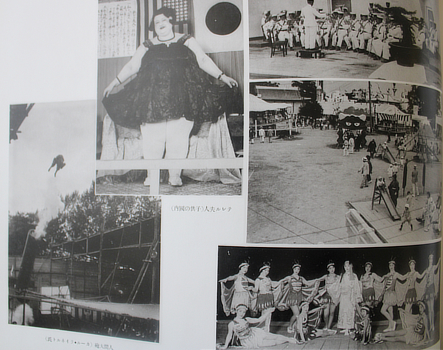
At the very end we find what seem to have been the big draws for the 600,000 plus visitors: the human cannonball, the world's fattest woman, and dancing girls.


You can email an inquiry or order securely through antiqbook

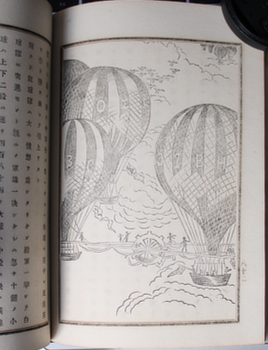
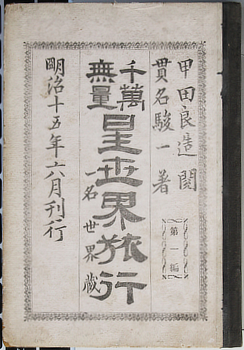
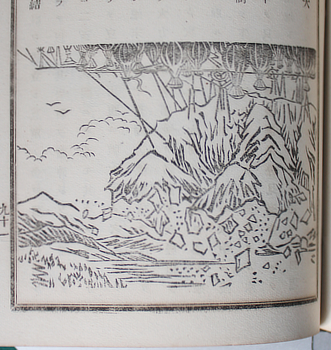
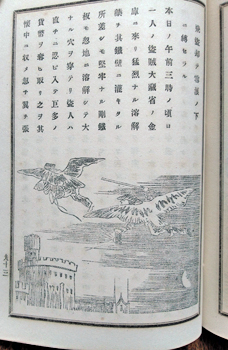
Nukina Shun'ichi. 千萬無量 : 星世界旅行 - 第一編 [Senman Muryo : Hoshi Sekai Ryoko - Dai-ichi-hen]. Kyoto, Nukina Shun'ichi 1882 (Meiji 15). 18x13cm publisher's cloth backed thin printed boards; [6],144,[3]pp, one full page and five half page illustrations. Brushed inscription on the last blank leaf. Edges a touch chipped, title and last leaf browned; a remarkably good copy of a vulnerable book. Au$6000

First edition of the first Japanese science fiction novel. This is proper interplanetary - intergalactic even - space travel, not old fashioned fantasy or fable. The title translates literally as 'Star World Travel'. For a while this was apparently regarded as a Jules Verne translation until someone figured out that there is no Jules Verne novel like this to translate.
This has never been translated and until very recently there was virtually nothing written in English and very little in Japanese on Nukina and his novel. Michal Daliot-Bul published two papers on this novel in 2021 and 22, Voyage to Innumerable Star Worlds, which are helpful but unfortunately written in Academic. A vague reference I found elsewhere to artificial life is expanded: on the dystopian planet of untrammelled technology and capitalism work will soon be done by artificially created organic humans - androids or robots - that are governed by three rules. It would be hard to argue that either Capek or Asimov pinched their ideas from Nukina but once again we find that no great notion doesn't have a precursor. Daliot-Bul also claims this as almost certainly the first utopian anarchist novel of Japan. The reason - she posits - for it's failure and disappearance.
This is volume one of what was meant to be a trilogy - containing five chapters - there is no more. At the end is a teasing hint of what chapters six to twelve might contain but we are unlikely to ever know for sure. 

I believe that last illustration is of a cop chasing a perp.


You can email an inquiry or order securely through antiqbook

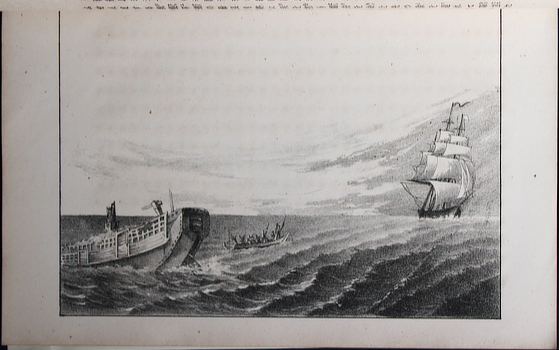
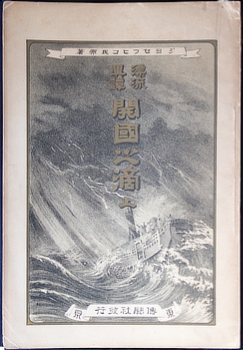
HECO, Joseph (ie Hamada Hikozo) & Hijikata Hisaakira. 開国之滴 : 漂流異譚 [Kaikoku no Shizuku : Hyoryu Itan]. Tokyo, Hakubunsha 1893 (Meiji 26). 22x15cm publisher's illustrated wrapper; two lithograph maps and a plate. A bit of browning, minor signs of use; a rather good copy of a book that didn't wear well. In a modern chitsu. Au$850

First edition in Japanese of volume one of Joseph Heco's autobiography, up to his return to Japan in 1862, translated by Hijikata. Volume two never appeared. There's a lot written about Heco: a castaway as a youth in 1850, rescued by an American ship; he became an American translator; he was the first Japanese person to be naturalised American; rubbed shoulders with presidents; returned to Japan, then the US, then Japan; is called the father of Japanese journalism ...
His Narrative of a Japanese, in two volumes, was worked up from his accounts written in English. The editor, James Murdoch*, wrote that he was given these notebooks in 1892 and asked whether they could be made publishable. He says that he did very little. What I don't know is when that Narrative appeared.
There must be writers whose books have been more miscatalogued and confused but I can't think who. The colophon of the Narrative is, I'm told, dated 1895 but I haven't found any reason for such a delay; and there must have been a gap between the first and second volumes. The Narrative was printed by The Japan Chronicle and published for Hamada Yoshi - who is also the owner of this edition - which makes me think it was a family matter. Heco, by this time, seems to have been fairly sick, he died in 1897.
The translator's preface here says, I think (remember that I'm illiterate), that volume one of the Narrative had appeared. Also (I think) the translator says that parts that explain Japan to Americans have been pruned while parts that explain America to Japan have been expanded. Where from? Maybe from Heco himself and diaries that weren't included originally. The translator is also a mystery to me. I doubt it's the future governor of the Bank of Japan, then a young law student.
One thing I can be definite about: any copy of the Narrative published in San Francisco does not date from before about 1950, no matter what the owner says.

*Murdoch, by the way, spent a lot of time in Australia before and after Japan; was a teacher of Natsume Soseki; briefly joined William Lane's New Australia settlement in Paraguay; and was the founding professor of oriental studies at Sydney University.
You can email an inquiry or order securely through antiqbook

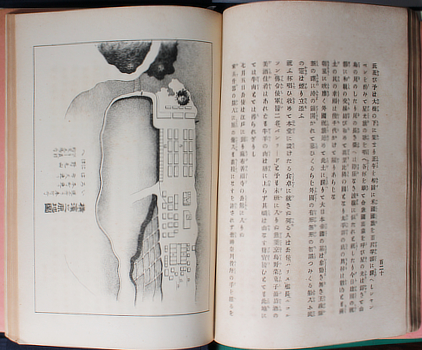
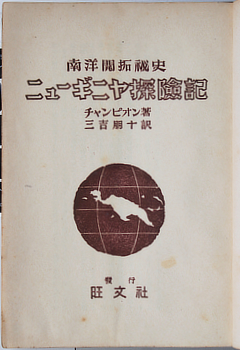
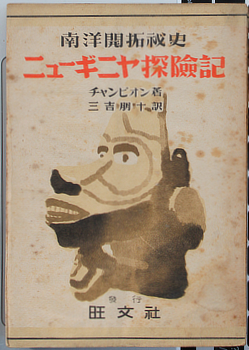
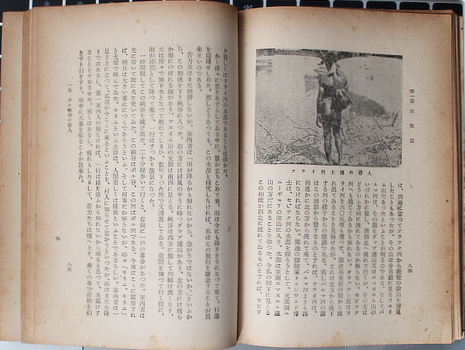
CHAMPION, Ivan & Miyoshi Tomokazu. ニューギニヤ探險記 : 南洋開拓秘史 [Nyuginiya Tankenki : Nan'yo Kaitaku Hishi]. Tokyo, Obunsha 1942 (Show 17). 18x13cm publisher's illustrated wrapper; map and small photo illustrations. Cheap paper browned but quite good. Unbecoming old tape stains on the endpapers, doubtless from a cover, which explains why the wrappers have survived so well. sold

First edition in Japanese of Ivan Champion's Across New Guinea From the Fly to the Sepik (1932), translated by Miyoshi. Miyoshi published heaps on the Philippines and south west Pacific and was particularly busy in 1942 when Japan suddenly needed to know about these mysterious dark places.
Worldcat finds two copies outside Japan, both in Taiwan. Maybe relics from the occupation?


You can email an inquiry or order securely through antiqbook

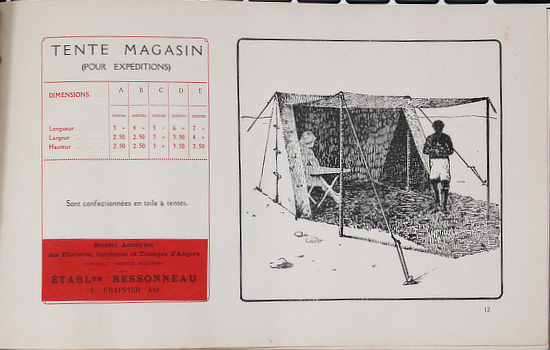
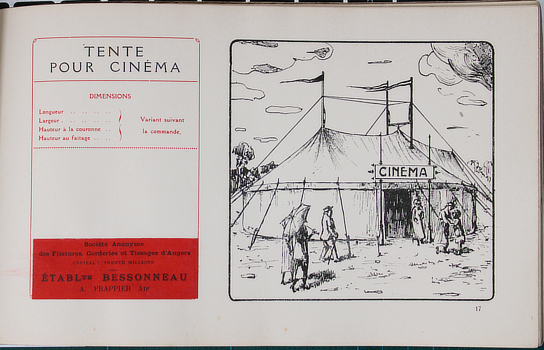
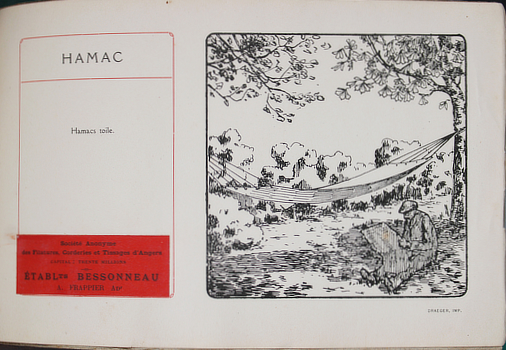
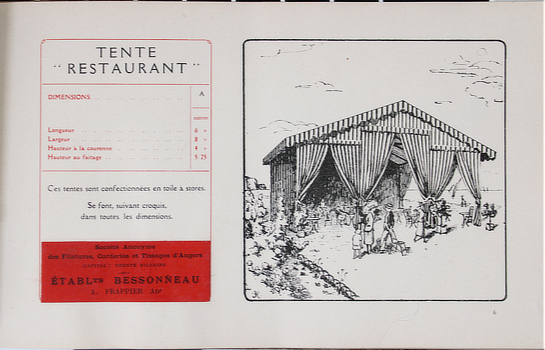
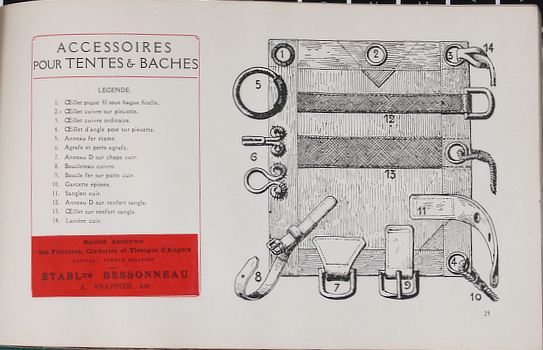
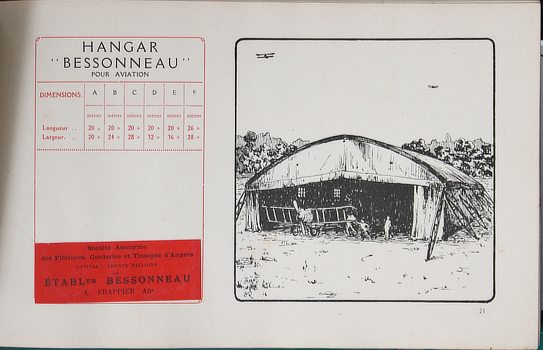
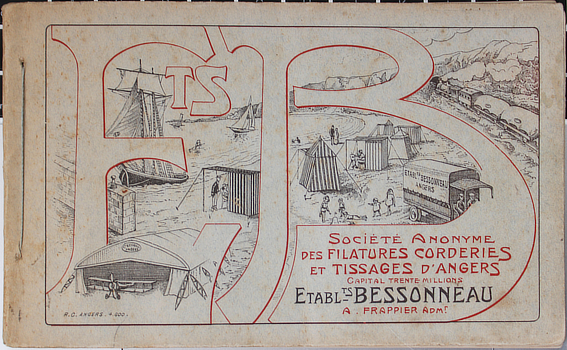
Catalogue - tents & more. Bessonneau, Angers. Etablts Bessonneau ... (cover title). Angers [191-?]. 13x22cm publishers illustrated wrapper, string tied; 35 leaves printed on one side. Minor signs of use. Au$650

From Bessonneau airplane hangars to a hammock, imagine canvas at work and Bessonneau have likely made it along with others you never thought of. Hospital, tick; colonial police office and expedition shop, tick, tick; restaurant, tick; horse cover, tick; cafe canopy, tick; cinema, tick; tarpaulins for trucks, wagons, barges, tick, tick, tick.
Rare? Tick.

Note that hammocks are still useful as shade for gentlemen of certain stature or age.


You can email an inquiry or order securely through antiqbook

The bloody battle of New Guinea

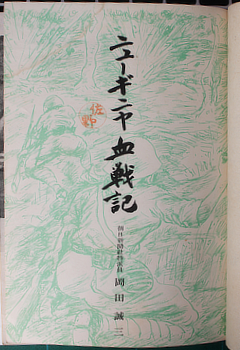
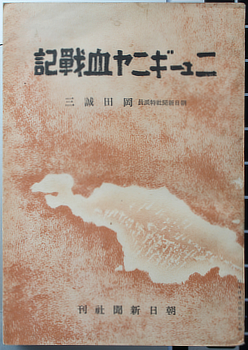
Okada Seizo. ニューギニヤ血戦記 [Nyuginiya Kessenki]. Tokyo, Asahi Shimbunsha 1943 (Showa 18). 18x13cm publisher's illustrated wrapper; illustrated title page, photo illustrations on four plates, a few b/w illustrations through the text, endpaper map. Paper browned but a rather good copy. Au$400
First edition. Okada reported for the Asahi Shimbun from New Guinea. He also turned part of his experiences into a short story and won the Naoki prize in 1944. He began a new career as a novelist after he retired from the paper, in the seventies. I read somewhere about the constraints he worked under writing about Japan's first defeat - something headquarters wanted erased. I have also heard of Japanese officers furious about soldiers continuing to return alive from battles as defeat loomed: they had already been reported dead. So they were sent out again.
Worldcat finds two locations in Taiwan and one in the US outside Japan.


You can email an inquiry or order securely through antiqbook

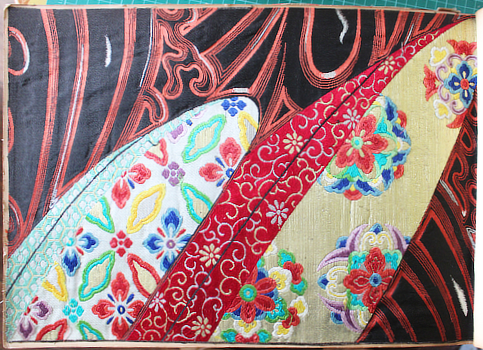
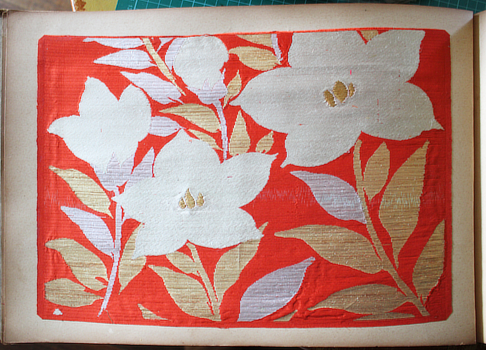
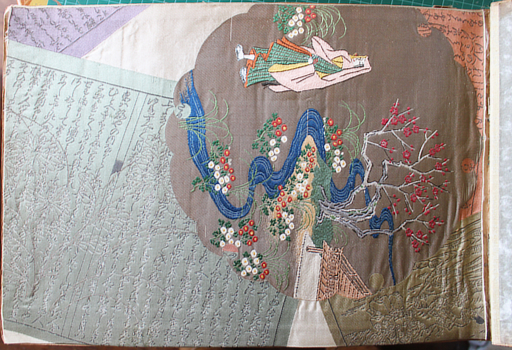
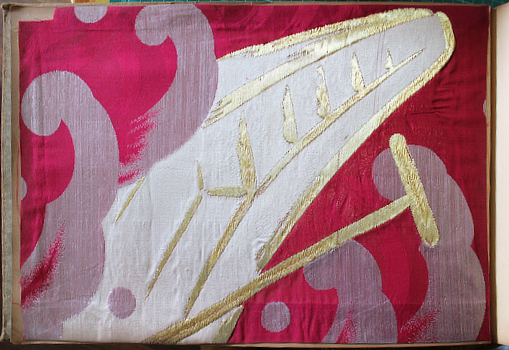
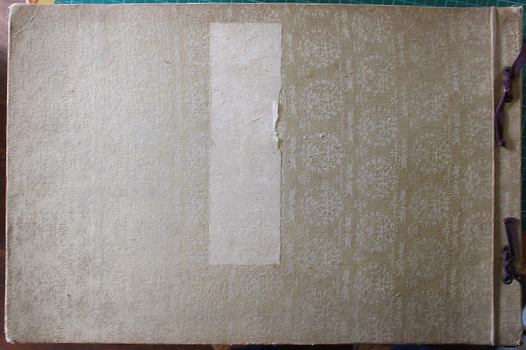
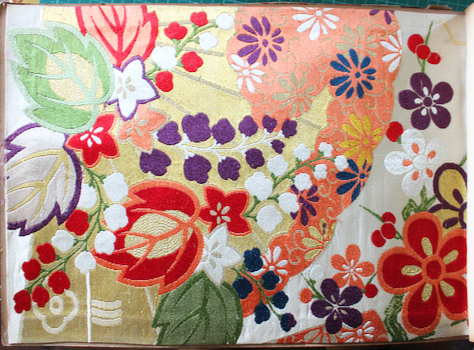
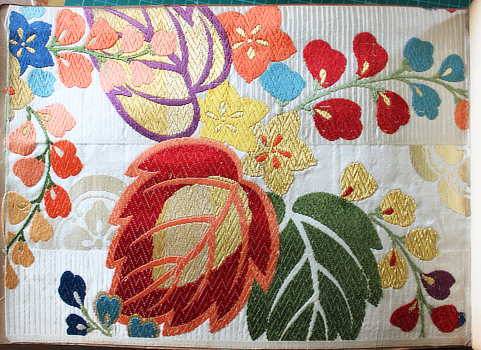
Textile embroidery sample album. [紫芳藏書]. An album of embroidered designs in silk. n.p. earlyish c20th. 30x45cm silk covered album, ribbon tied; 40 samples on 43 card leaves (two have been removed and one leaf was left blank). Signs of use but nothing worrisome. Au$750

A formidable collection of large, if often overwrought, designs in embroidered silk. I take these to be Obi designs but I'm no expert. The first design, perhaps a scene from some antique romance, features an illustrated book that looks as if it could be read by someone literate.
A stamp at the very end tells us this is the shihokurashu - purple fragance collection - and this is no.469. Purple is not a predominant colour anywhere so it must be the spirit of an ineffable fragrance at work.


You can email an inquiry or order securely through antiqbook

Sherlock Holmes

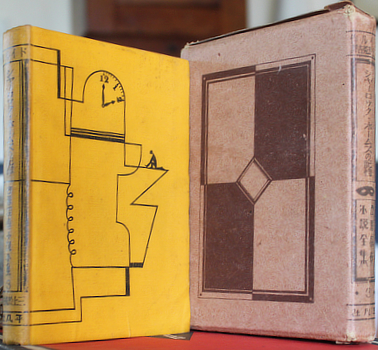
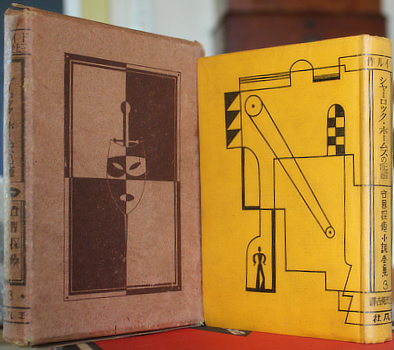
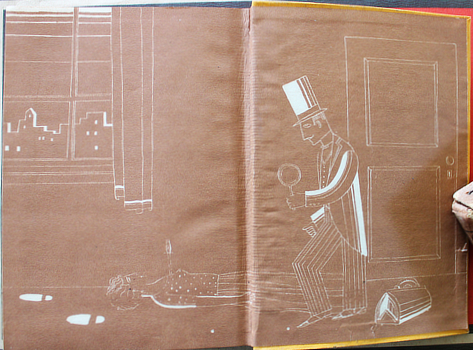
DOYLE, Arthur Conan & Mikami Otokichi. シャーロック ホームズの記憶 [Sharokku Homuzu no Kioku]. Tokyo, Heibonsha 1930 (Showa 9). 15x12cm publisher's illustrated flexible yellow cloth printed in black, printed card slipcase; frontispiece. Minor signs of use; edges browned, quite good for a pocket detective novel bound in bright yellow; seldom found with its box. The frontispiece is drab, the endpapers - which are common to the series - delightful. Au$350

First Japanese edition of the Memoirs of Sherlock Holmes. Mikami was a phenomenally busy and succesful novelist who apparently worked best in brothels. His partner, novelist Hasegawa Shigure, said it was the only way he could write. When he couldn't write she filled in.
This is volume 3 in the Complete Collection of World Detective Novels which I think ran to 20 volumes and was published in no particular order in 1929 and 1930. Volume 4 was Mikami's translation of The Return of Sherlock Holmes which I think beat this into print. I can tell you that volume 18 also came before this. Don't confuse this with the Complete Collection of World Detective Novels published by Hakubunkan at the same time.
The binding has a strong family resemblance to one by Onchi Koshiro for an Ars photography book the same year but this isn't any guarantee of anything.


You can email an inquiry or order securely through antiqbook

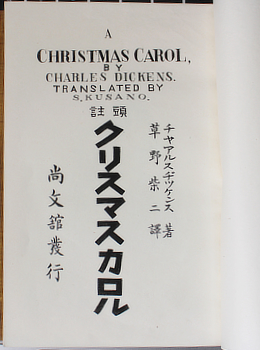
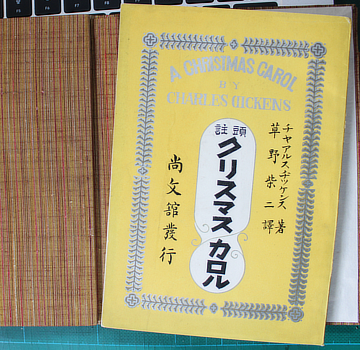
DICKENS, Charles & Kusano Shibaji. クリスマス カロル [Kurisumasu Karoru] A Christmas Carol. Sendai, Shobunkan 1902 (Meiji 35). 19x13cm publisher's yellow wrapper printed in black and silver; frontispiece portrait. A fabulous copy in a cloth case by binder, writer and fastidious collector Ikuta Atsuo. Au$500

First Japanese translation of A Christmas Carol and quite early in Japanese Dickens. They didn't take to Dickens with the same enthusiasm as with more exciting writers like Bulwer Lytton. Some fragments were published in the eighties and nineties but I think the first Dickens to become a book was the Child's History of England (1891), a shame. This might be the second book. Once it was realised how soppy and didactic this Christmas story is, not to mention ghosts and time travel, there was a plethora of new translations and editions over the next few decades.


You can email an inquiry or order securely through antiqbook

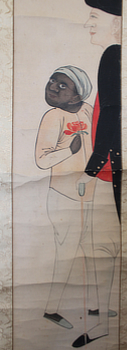
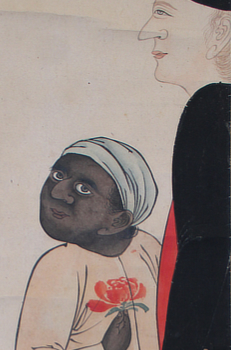
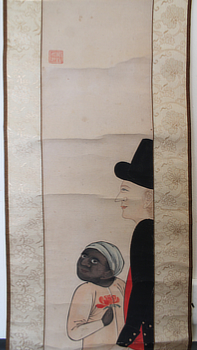
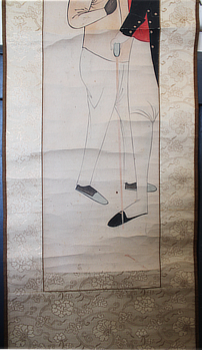
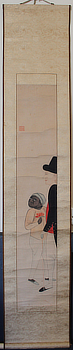
Japanese portrait of a Dutch man's servant or slave and his master. n.p. late 18th or early 19th century? 93x16cm painting in ink and colour on paper, mounted on a scroll, 144x27cm. Some creases. One of the scroll ends has come adrift but is there; I'm not going to glue it back on. In a modern wood scroll box. Au$1500

An impressively long narrow painting, the proportions of a pillar print which were popular in the late 18th century. Really a portrait of the attendant rather than the master. He is just there to frame and give scale to the centre of the painting. I have noticed in paintings of the Dutch and their attendants that far more attention is paid to the attendants. One tall blonde man with blue eyes looks much like another.
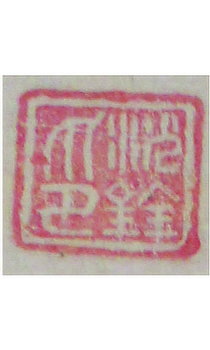
There is red seal fairly high up on the left which remains obstinately unread; I suspect it is an owner's seal. This is not by a great painter but it is a good picture and has been treasured.
The red chrysanthemum is a curious touch. It might symbolise love but the way it's been brushed over the tunic might suggest a blood stain. He could be gazing in adoration or he could be measuring whether he can reach that man's throat with a sharp blade.


You can email an inquiry or order securely through antiqbook

To the moon with no inns along the way

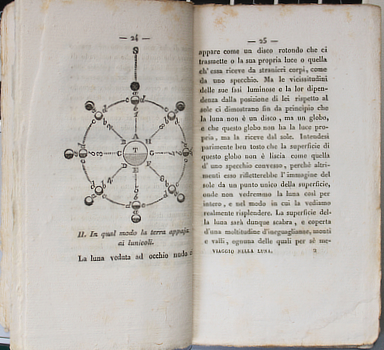
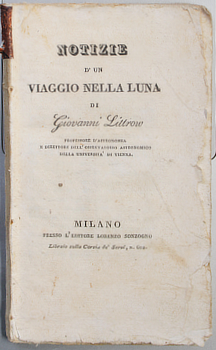
LITTROW, Giovanni [ie Joseph Johann von]. Notizie d'un Viaggio nella Luna. Milan, Lorenzo Sonzogno [1831? or 1836?]. 12mo disbound, untrimmed; 88pp, a diagram in the text. A little browning, no half title called for. Au$750

First edition? We are told this was compiled from a March to May 1831 series in the Biblioteca Italiano (did it exist?) in turn taken from the Gazzetta Vienese (did it exist?) and I can't find any other form of it until another Italian edition in 1872. We are promised this is a serious exposition on a trip to the moon by the distinguished astronomer, not fiction, but then, we were promised the same thing with Herschel's moon discoveries. 
I wonder if this was worked up when the moon hoax hit Italy in 1836. It seems too good to be true that a distinguished astronomer had recently published speculations on a trip to the moon in a journal that I can't find. It may be that Sonzogno just looked around for anything to cash in and this is kosher. This and the moon hoax items that follow were obviously all in the same volume at one time. I doubly curse whoever pulled in apart. 
Littrow begins with some of the difficulties: the time it will take to get there at the rate of the fastest carriage, or even a ship pushed by a hurricane; the lack of inns with decent food along the way; the lack of air.
Worldcat finds two locations in Italy and possibly one in America. The later edition is easier to find.


You can email an inquiry or order securely through antiqbook

The great moon hoax in Italy

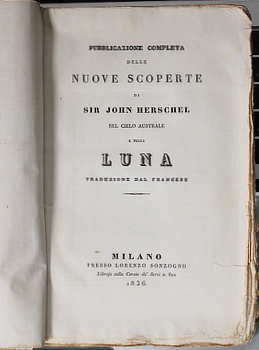
Herschel. [LOCKE, Richard Adams]. Pubblicazione Completa delle Nuove Scoperte di Sir John Herschel nel Cielo Australe e nella Luna. Traduzione dal Francese. Milan, Lorenzo Sonzogno 1836. Octavo disbound, untrimmed; 104pp. With half title. Au$750

This comes from the anonymous French version by Fourierist Victor Considerant and general hack Raymond Brucker. Their publishers, Masson & Duprey, tell us they have made a deal with Herschel's publisher Murray and promise that the full work in four volumes will be published on the same day as the London edition. When you're handed a delightful hoax run with it. All this is repeated here.
Locke's account in the New York Sun in August 1835 of Herschel's discovery with his revolutionary new telescope of life on the moon was the first definite report by a credible scientist and the news spread faster than a trip to the moon would take. The French might have been first with a translation - might have - but it seems to me that no-one took to this discovery with greater relish than Italy. Accounts of varying forms blossomed in cities all over Italy. This one is quite handsome, specially when compared with the plain Jane New York original.
Worldcat finds two locations outside Italy.


You can email an inquiry or order securely through antiqbook

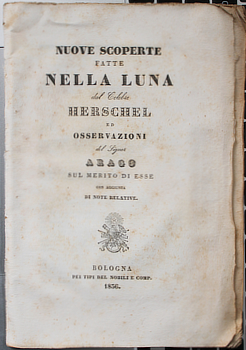
Herschel. [LOCKE, Richard Adams]. Nuove Scoperte Fatte nella Luna dal Celebre Herschel : ed Osservazioni del Signor Arago ... Bologna, Nobili e Comp 1836. Octavo disbound, untrimmed; 32pp (last blank). A little browning; no half title called for. Au$750

These Bologna publishers are thorough spoil sports and have based this around the expose address by Arago - if there was such a thing. On page 25 we read about the French versions (a rough translation): To make this deceptive mockery more complete, it ... now runs through the streets always with the name of the illustrious Herschel on the front. By page 25 the reader has presumably forgotten our title page.
Worldcat finds no entry for this, neither did a search of Italian union catalogues.


You can email an inquiry or order securely through antiqbook

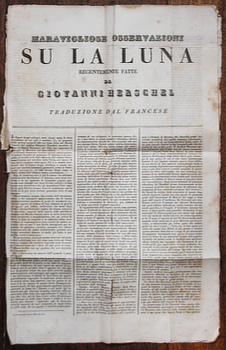
Herschel. [LOCKE, Richard Adams]. Maravigliose Osservazioni su la Luna Recentement Fatte da Giovanni Herschel. Traduzuione dal Francese. Reggio, Torreggiani e Compagno March 1836. 45x29; four pages, disbound with remant of binding tab. Folded; some browning, a tear in the centre fold and small holes and splits elsewhere. Au$750

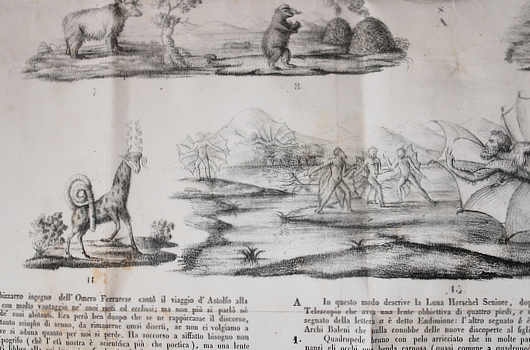
This begins with the questions of Arago but shows that now that the whole account has been translated doubt has been banished. But the writer confesses at the end that they don't see how any creature can have arms, legs and wings. This is the same sort of half-baked criticism that was aimed at low budget alien invasion films a century later when we were told spiders and crabs twelve storeys high could not support themselves.
Worldcat finds no location, neither did my searches of Italian union catalogues. There is probably a copy in the Museo Galileo but I can't get the catalogue to work.


You can email an inquiry or order securely through antiqbook

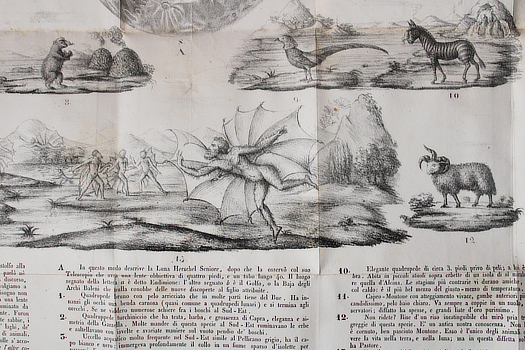
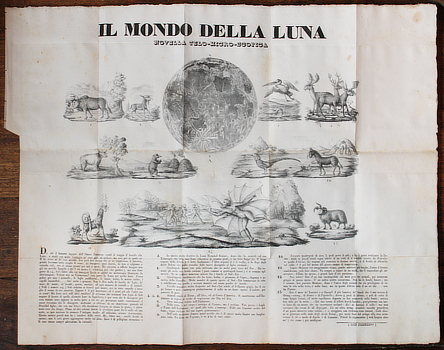
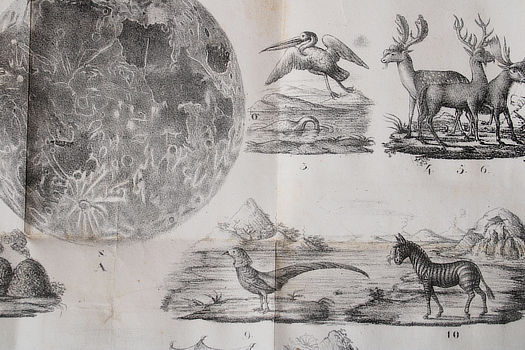
Herschel. [LOCKE, Richard Adams]. Il Mondo Della Luna Novella Telo-Micro-Scopica. n.p. n.d. [1836?]. 47x58cm broadside with lithograph illustrations over descriptive text. Folded, left margin trimmed to form a tab showing it was at sometime bound into a book. A little browning, rather good. Au$1500

Here we have handsome portraits on good heavy paper of what Herschel saw. We're told this was printed with permission but whose?
The New York Sun published one or two separate lithographs after the fact (one illustration I found credited to the Sun exists as a Milan lithograph - were there both?); one of the British pamphlets had a crude woodcut; Thierry Freres of Paris issued a lithograph; the most reproduced now are the views by Leopoldo Galluzzo in Naples which mixed in a trip by earthlings to the moon; no doubt there were others.
Our print remains mysterious. There might be a copy in a Milan collection but I'm not smart enough to find it.


You can email an inquiry or order securely through antiqbook

A weapon called a camera

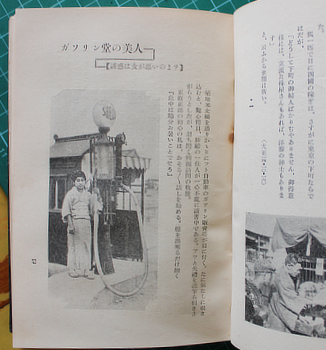
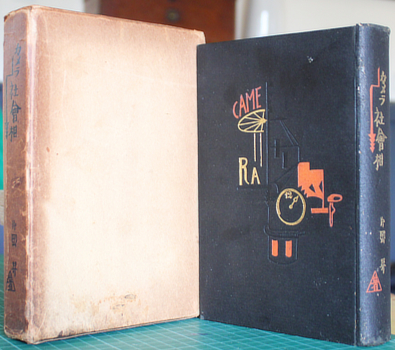
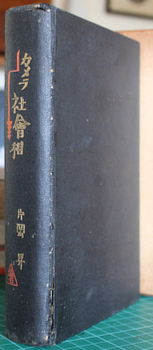
Kataoka Noboru. カメラ社会相 [Kamera Shakaiso]. Tokyo, Bungei Shijosha 1929 (Showa 4). 20x14cm publisher's cloth blocked in blind, red and gilt, card slipcase (some holes in the back hinge have been touched up by some wrong-headed owner; the box is quite browned); photo illustrations throughout. First and last couple of pages browned. An unnumbered copy of an edition of 500 copies. Au$200

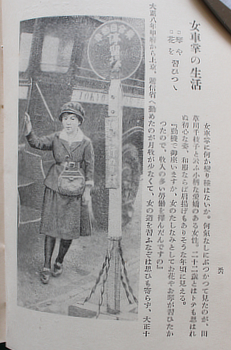
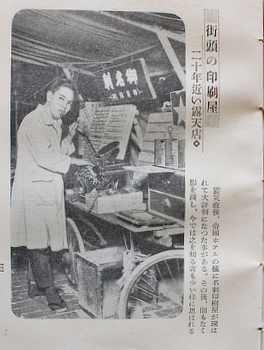
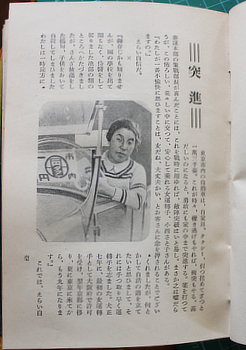
I found a reference somewhere calling this a work of modernology, ie the study of ordinary people, their daily lives, what they do, what they use ... but I don't know that Kataoka had any connection to modernologist Kon Wajiro. I think it was a similar impulse from a different direction that sent Kataoka out on the street with his camera. He wrote, "I have a weapon called a camera. I snap a picture, and when I ask them to talk, most of them are soft-spoken and start talking about their lives, which is a real perk of being a photographer" (a crude translation). The first part photographs and interviews 93 people at work, including a woman bus conductor and gas pump attendant. After that it's not so interesting: celebrated worthies.
This was issued as an edition of 500 copies in a leather binding which might have been smart when new but the leather fell to pieces pretty fast. So it's not hard to find copies in ruin but not so easy to find a cloth binding in reasonable shape. My guess is that a few extra copies were put out in cloth.
The binding design is by Sakai Kiyoshi, I presume the writer credited with kick starting the ero-guro-nansu fad. Some of his books came from the same publisher.


You can email an inquiry or order securely through antiqbook

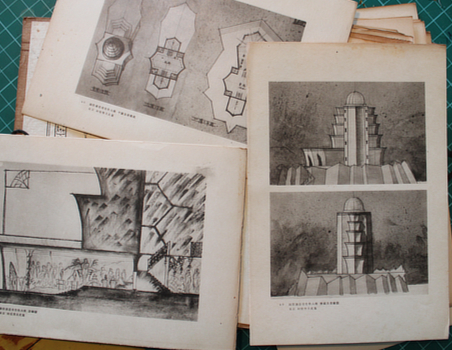
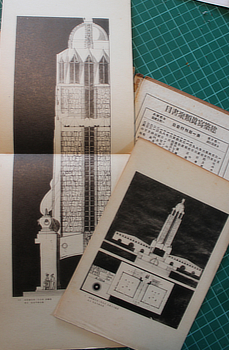
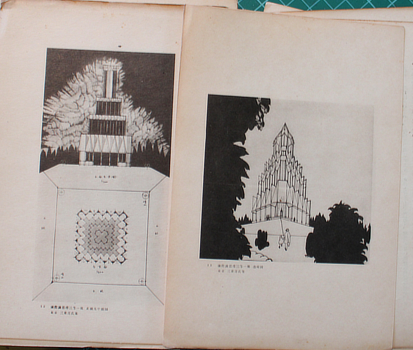
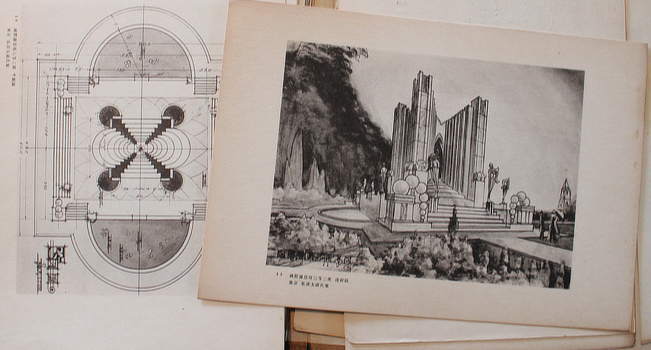
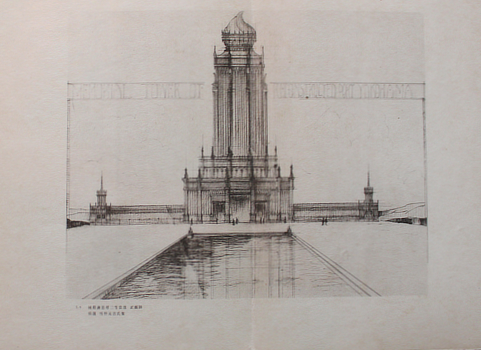
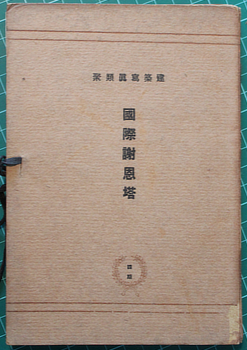
Architecture competition. 国際謝恩塔 [Kokusai Shaonto]. Tokyo, Koyosha 1924 (Taisho 13). 19x13cm, loose as issued in publisher's printed boards; 50 leaves, mostly plates printed on one side (actually 48 as two are double page carrying two numbers); renderings, elevations and plans. Wear to spine, dust marks or darkening to the very top edge of several plates, a decent secondhand copy. sold

Here are the winners and honourable mentions from a competition for a tower of gratitude for international aid after the 1923 earthquake. First and second prizes are graced with overwrought dramatics but are hardly radical. Things get more interesting after that.
One of the apparently endless series of small architecture monographs, Kenchiku Shashin Riuju. I wonder if anyone knows how many there were. Some are intriguing and some are pretty drab. Many require a dogged love of gateways and tea rooms. This one is up top.
Outside Japan, Worldcat finds an entry at Queensland University, dated 1929 for some reason, but the university's four entries for the title, including a microform, don't actually locate a copy.


You can email an inquiry or order securely through antiqbook

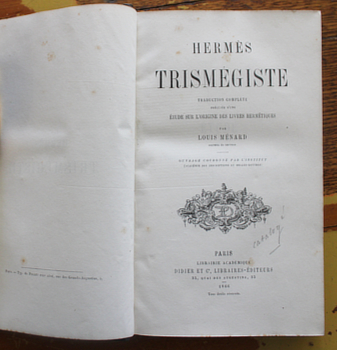
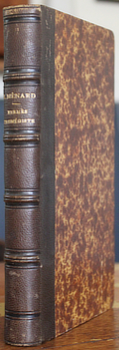
Hermes Trismegiste. Louis Menard. Hermes Trismegiste : traduction complete ... etude sur l'origine des livres hermetiques. Paris, Didier 1866. Octavo quarter morocco and mottled boards. Occasional patches of browning depending on paper stock. Rather good. Au$200

First edition; there were a few more over the next hundred years. Menard was another of those damn French socialists of the 1840s, fleeing to London after 1848 to escape a prison term. He settled down eventually into a life of respectable mystic paganism and pedagogy.


You can email an inquiry or order securely through antiqbook

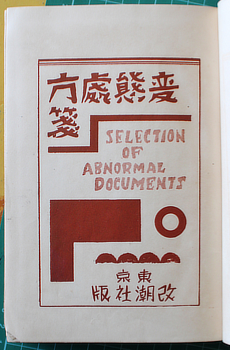
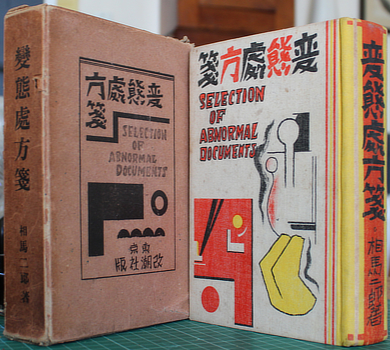
Soma Jiro. 変態処方箋 [Hentai Shohosen] Selection of Abnormal Documents. Tokyo, Kaichosha 1930 (Showa 5). 19x14cm publisher's illustrated fawn cloth printed in red, yellow and black, printed card slipcase (torn but all there). Browning and smudging of the cloth, edges browned and scattered light browning through the text. A read copy, I'm sorry, but pretty good for this book. Au$150

Maybe the first printing of this substantial classic of the ero-guro-nansensu (erotic grotesque nonsense). The colophon is dated 24th and 29th of June but the cloth and paper are different from another copy I've seen with the same dates.
According to Hakkin Hon (banned books): Bessatsu Taiyo, the book was banned four days before publication and 295 of the 1000 copies produced were seized.
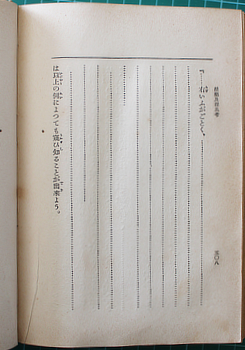
And I found another note on this book that tells us that 38 printings appeared within four months - with 25% of the text blanked out and at least one all blank page. That must be page 508, which in an August printing is columns of dots. But this is all a muddle. This copy is partly censored: page 508 is also columns of dots while the other pages I compared to that August 'first edition' are untouched here. I haven't done a page by page comparison.
I have traced, but not seen, a claimed 38th edition but nothing between one and 38. It makes sense now; they are all, however many there are, first editions without mention of earlier printings.
Hentai Shohosen might translate as 'A Prescription for Perverts'. Drugs, sex toys, punishment, cannibalism and a list of everyday items used by foreign women for masturbation appear among the chapters. So I'm told. Thank goodness I can't read it.
What I really want to know is who did the cheerful cover - one that could double for a book on Japanese motherhood - and box/title page. Designer's names are often tucked away in dim corners but I can't find it.


You can email an inquiry or order securely through antiqbook